


Download User Manual
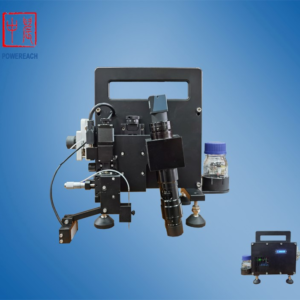
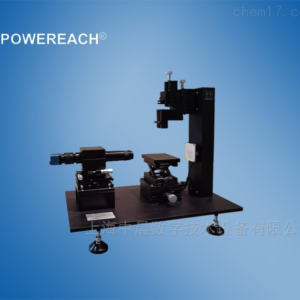
The Micro Electrophoresis System / Zeta Potential Analyzer developed and manufactured by Shanghai Zhongchen has been on the market for 28 years and was the outcome of a project funded by the National Innovation Fund. This instrument can be used to determine the solid-liquid interfacial electrical properties (Zeta potential) of dispersed particles, as well as the interfacial electrical properties of emulsion droplets. It can also be used to determine the isoelectric point and study the mechanism of interfacial reaction processes. Determining the isoelectric point by measuring the Zeta potential of particles is an important method for understanding the surface electrical properties of particles and is also a crucial tool in particle surface treatment. Compared with other similar instruments, it has significant advantages. It can be widely used in industries such as cosmetics, mineral processing, papermaking, medical and health care, building materials, ultrafine materials, environmental protection, and marine chemistry. It is also one of the important educational instruments for disciplines such as chemistry, chemical engineering, medicine, and building materials.
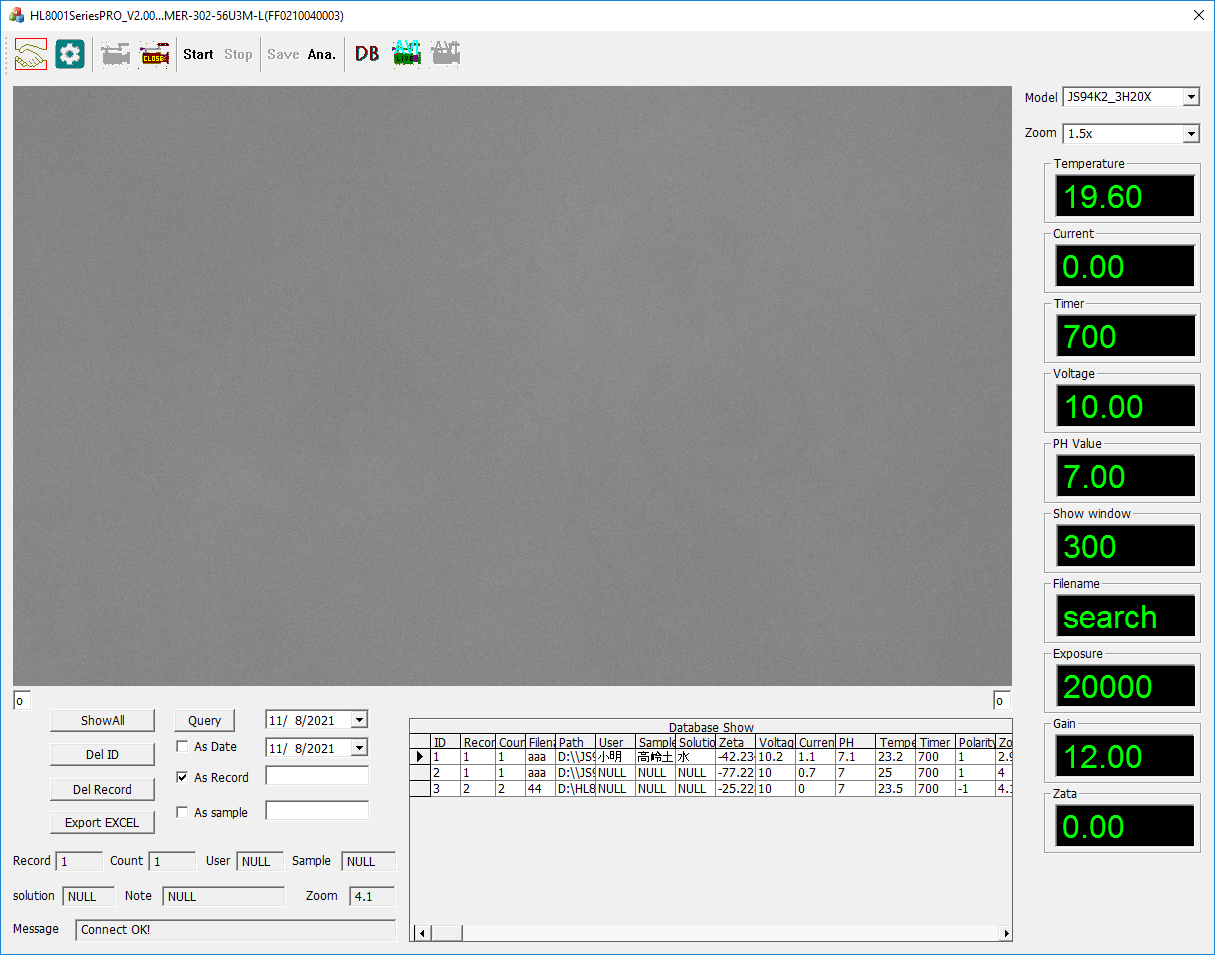
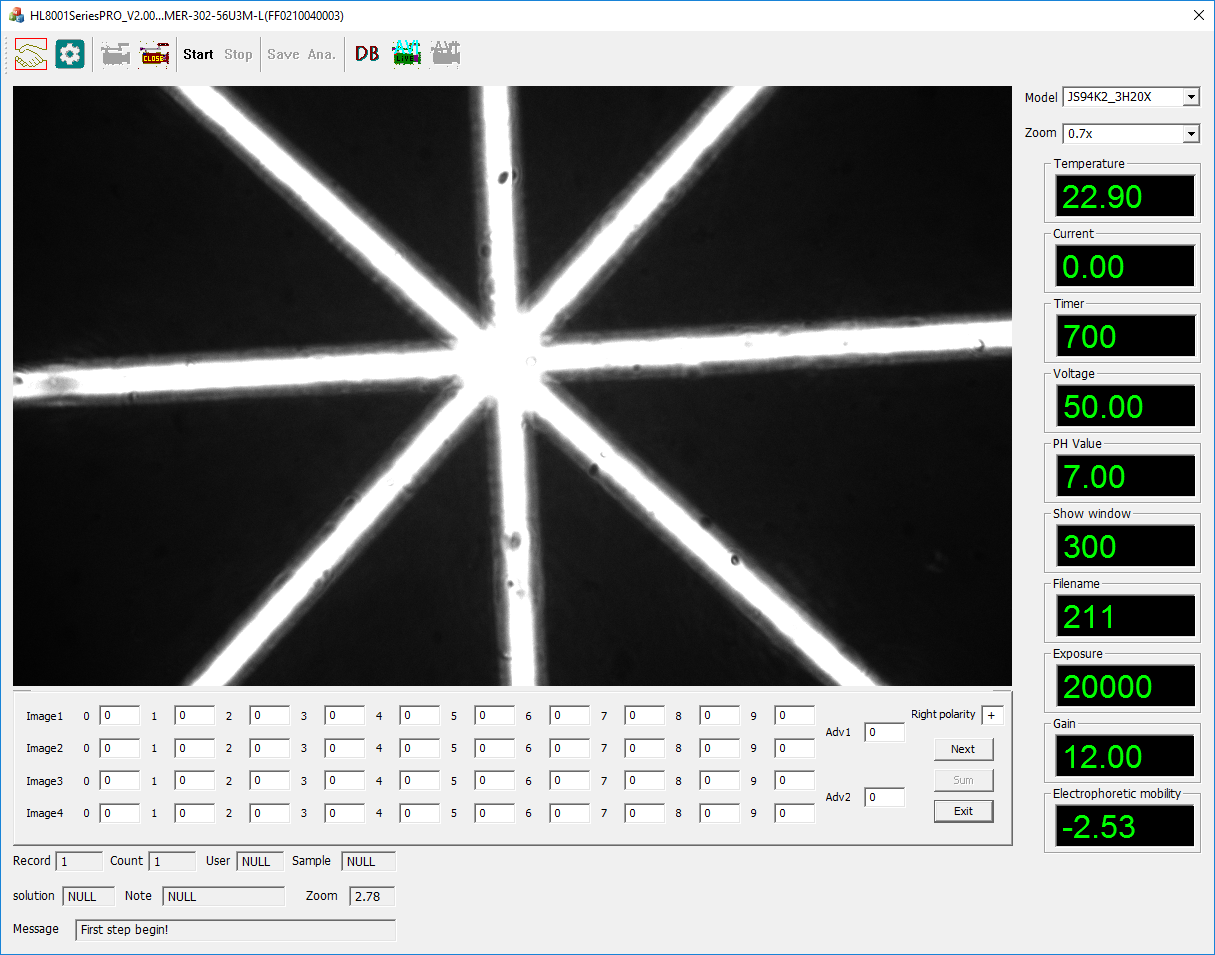
The first national standard, “Analysis of Zeta potential of colloids — Electrophoresis guidelines”, standard number GB/T 32668-2016, has been released and came into effect on November 1, 2016. The microelectrophoresis method described in this standard is based on the JS94 series Micro Electrophoresis System / Zeta Potential Analyzer developed and manufactured by Shanghai Zhongchen. The image on page 16 of the standard shows the software interface of the JS94 series.
Models of JS94 series
| Model | Applicable systems | Particle size range (µm) | Microscopic optical system | Resolution |
| JS94H | Aqueous systems | 0.5~20 | High-magnification | 4 pixels/µm |
| JS94H2 | Aqueous systems & Organic systems | 0.5~20 | High-magnification | 4 pixels/µm |
| JS94J | Aqueous systems | 0.1~10 | WKD High-magnification | 12 pixels/µm |
| JS94J2 | Aqueous systems & Organic systems | 0.1~10 | WKD High-magnification | 12 pixels/µm |
| JS94K | Aqueous systems | 0.2~50 | Continuous zoom optical system, suitable for measuring a wider range of particles. | 8 pixels/µm |
| JS94K2 | Aqueous systems & Organic systems | 0.2~50 | Continuous zoom optical system, suitable for measuring a wider range of particles. | 8 pixels/µm |
The above are six classic models with upgrades, offering improved quality and efficiency without increasing price.
The following are six new electrical models.
| Model | Applicable systems | Particle size range (µm) | Microscopic optical system | Resolution |
| JS94HAU-3H10X | Aqueous systems | 0.5~20 | High-magnification | 3 pixels/µm |
| JS94H2AU-3H10X | Aqueous systems & Organic systems | 0.5~20 | High-magnification | 3 pixels/µm |
| JS94JAU-1K20X | Aqueous systems | 0.1~10 | High-magnification | 11 pixels/µm |
| JS94J2AU-1K20X | Aqueous systems & Organic systems | 0.1~10 | WKD High-magnification | 11 pixels/µm |
| JS94K2AU-3H20X | Aqueous systems | 0.2~50 | Electric Continuous zoom optical system, suitable for measuring a wider range of particles. | 1.93 ~ 12 pixels/µm |
| JS94K2AU-3H20X | Aqueous systems & Organic systems | 0.2~50 | Electric Continuous zoom optical system, suitable for measuring a wider range of particles. | 1.93 ~ 12 pixels/µm |
JS94 Standard Components
- USB Digital CCD (1 unit)
- Silver Electrode (1 unit)
- Platinum Electrode (1 unit)
- POM Electrode (1 unit, JS94H2, JS94J2, JS94K2 models)
- Electrophoresis chambers (10 units)
- Crosshair (1 unit)
- Software and Operation Manual (Soft copy, 1 copy)
- Operation Manual (hard copy, 1 copy)
- Computer with Pre-installed Application Programme and Drivers (1 unit)
JS94 Series Specification
- Employs microelectrophoresis, conforming to GB/T 32668-2016 “Analysis of Zeta potential of colloids — Electrophoresis guidelines”.
- Power Consumption: <150W; Input Voltage: 220V~250V 50Hz
- Applicable Environment: Vibration-resistant platform; Applicable Temperature Range: Room temperature to 35℃; Reading Accuracy: 0.1
- Measurement Accuracy: System error within 5%
- pH Range: Generally applicable from 2.0 to 12.0, also usable from 1.6 to 13.0
- Cup-shaped open electrophoresis chamber with specially designed electrode holder
- Can measure Zeta potential and isoelectric point of dispersed systems
JS94 Series Features
- The instrument has a newly designed, simplified electrophoresis chamber with a 0.5cm thick glass container. The electrodes are placed within the chamber. The electrophoresis chamber and internal electrodes are precisely calculated using microfluidic field techniques and surface treated, forming an electrophoresis device completely different from traditional electrophoresis device. Very little sample is required during testing, only 0.5ml per test. It is easy to clean, convenient to use, and economical.
- A meticulously designed electrode holder fits tightly with the electrophoresis chamber, forming a cup-shaped open electrophoresis device. The electrodes are made of silver, platinum, and titanium wire, renowned for their stable performance which is achieved by surface treatment.3
- A well-crafted crosshair is used. After placing the crosshair in the electrophoresis chamber and the chamber on a 3D platform, adjusting the platform allows a clear crosshair image to be displayed on the computer screen, locating the measurement position. There is no stationary layer issue.4
- This electrophoresis device employs a semiconductor light-emitting near-field optical system with a power consumption of only tens of microwatts. This prevents heat generation from affecting the measurement environment and accuracy. The optical system has been adjusted to increase magnification, and shorter wavelengths of blue and green light are used, allowing for the visualization of even smaller particles.5
- A constant-voltage low-frequency AC power supply is used, preventing polarization and significantly improving measurement speed. The positive-to-negative commutation time is continuously adjustable from 0.30 seconds to 1.20 seconds, and the sampling time is only 3-10 seconds. The voltage between electrodes can be adjusted as needed.6
- A temperature probe automatically and continuously samples the ambient temperature, sending the data back to the computer for automatic parameter adjustment to calculate the Zeta potential. Utilizing computer multimedia technology, it automatically and continuously “photographs” ultrafine particles magnified 1200 times at a given cycle time, providing four bidirectional grayscale images for analysis and calculation.7
- The unified software is adaptable to various models in this series through software settings. No further training is required for customers using instruments with different configurations and models.8
- Customizable higher magnification imaging systems are available.
Please contact us for technical consultation and a quote.